
Vietnam Coracle
Last updated November 2024 | Words and photos by Vietnam Coracle | 80 comments
Côn Đảo and Phú Quốc are two of the most attractive beach destinations in Vietnam. Lying off the southeastern and southwestern coast of Vietnam respectively, both of these tropical islands have good beaches, jungle-covered interiors, great seafood, watersports, outdoor activities and regular transportation connections to the mainland. Both have a history as prison islands and associations with Nguyễn Ánh, a pivotal historical figure who became Emperor Gia Long, founder of Vietnam’s last imperial line, the Nguyễn Dynasty. I love Côn Đảo and Phú Quôc and I have visited dozens of times over the last two decades. But most travellers will only have time to visit one: so which island should you choose?
[Back Top]
Which of these Tropical Islands Should You Choose?
This guide compares Côn Đảo and Phú Quốc based on 8 criteria (see Contents below). If choosing between the two, there are many things to consider, including time of year, weather conditions, budget, and personal preferences. Although I love both Côn Đảo and Phú Quốc, in many respects these two southern islands are very different in character: for some travellers, one will appeal more than the other. There are several other small archipelagoes off Vietnam’s southern coast, including Hòn Sơn, Nam Du and the Pirate Islands (Đảo Hải Tặc). But these are more suitable for shorter trips or island-hopping, whereas travellers can happily spend between 3-10 days on either Côn Đảo or Phú Quốc. As well as this guide, I have written extensively about both islands in my Côn Đảo Travel Guide and Phú Quốc Beach Guide, and many more articles in Related Posts.
CONTENTS:
Map
Weather
Transportation
Beaches
Natural Environment & Tourist Development
Accommodation
Dining & Nightlife
Sights & Activities
Costs & Value for Money
Related Guides
Southern Islands: Côn Đảo & Phú Quốc
[Back to Contents]
Weather:
Although both islands lie off the coast of southern Vietnam, they are located in different seas and subject to different weather patterns. Phú Quốc is in the Gulf of Thailand, while Côn Đảo is in the East Sea. Broadly speaking, Phú Quốc has two distinct seasons: the wet (June-October) and the dry (November-May). The best weather and sea conditions are in the dry season, when the sun usually shines, the ocean is generally calm and clear, and nighttime temperatures are cool. Rainy season months can be very wet and the sea gets choppy - often too rough to swim. Côn Đảo’s weather patterns are more complicated. The driest months (November-February) are also the windiest, making the seas too rough to swim or dive, and beaches unpleasant to lay out on. The best window for visiting Côn Đảo is March to September, when winds subside, the ocean calms, and temperatures range between mild and very hot, but there’s always the chance of heavy rain and storms during this period. Bottom line: visit Phú Quoc from November-May; visit Côn Đảo from March-September.


[Back to Contents]
Transportation:
Both islands are well connected to mainland hubs, whether by air or sea. The biggest difference between the two is that Phú Quốc receives international flights, but Côn Đảo’s airport is domestic only. Interestingly, there’s currently no direct connection, by air or sea, between the two islands, but I would imagine it’s just a matter of time before one opens. Ultimately, Phú Quốc is easier and cheaper to reach than Côn Đảo. You can search and book flights or ferries to Phú Quốc and Côn Đảo using this Baolau.com link or the search box below.
By Air: There are dozens of flights every day to/from Phú Quốc and major Vietnamese cities, such as Ho Chi Minh City, Hanoi and Đà Nẵng. All Vietnamese carriers fly to Phú Quốc which means competition is fierce and prices are reasonable. In addition, Phú Quốc receives regular charter flights from international destinations, such as Thailand, South Korea and Eastern European nations. By contrast, Côn Đảo’s small airport only receives about a dozen flights each day from Ho Chi Minh City and Hanoi, with seasonal connections to other domestic destinations, like Cần Thơ, Đà Nẵng and Vinh. The short runway can only accommodate particular aircraft, so not all domestic carriers fly to Côn Đảo. This means that flights to Côn Đảo cost around 50% more than those to Phú Quốc. Bottom line: flights to Phú Quốc are cheap and frequent; flights to Côn Đảo are expensive and few.
By Sea: Phú Quốc has dozens of daily passenger and vehicle ferry connections from two ports in the Mekong Delta: Rạch Gía and Hà Tiên. Journey time is 2.5 hours and 1.5 hours respectively. Hà Tiên is the more pleasant of the two port cities, but Rạch Gía has better bus connections to Ho Chi Minh City. Côn Đảo has direct ferry connections from Vũng Tàu, Trần Đề (in the Mekong province of Sóc Trăng), and Cần Thơ (seasonal) and Ho Chi Minh City (not operating at the time of publication). The voyage from Sóc Trăng (twice daily) is the shortest (2.5 hours) and most reliable, but getting to the port involves a long bus journey from Ho Chi Minh City (6-7 hours). The voyage from all other ports takes 4-5 hours, but sailings are just a few times per week and schedules are subject to change due to rough sea conditions. Bottom line: ferries to Phú Quốc are frequent and reliable; ferries to Côn Đảo are fewer and less reliable. (For much more information about all these ferry connections, see my individual ferry guides in Related Posts.)
Getting Around: Both islands are easy to get around. Roads are good, taxis are cheap and easy to find, including rail-hailing apps, such as Grab and Xanh SM, and motorbikes can be rented. However, Phú Quốc has something that Côn Đảo doesn’t: a free, all electric, island-wide bus network operated by VinBus.
Search & Book Transportation to/from Phú Quốc & Côn Đảo:


[Back to Contents]
Beaches:
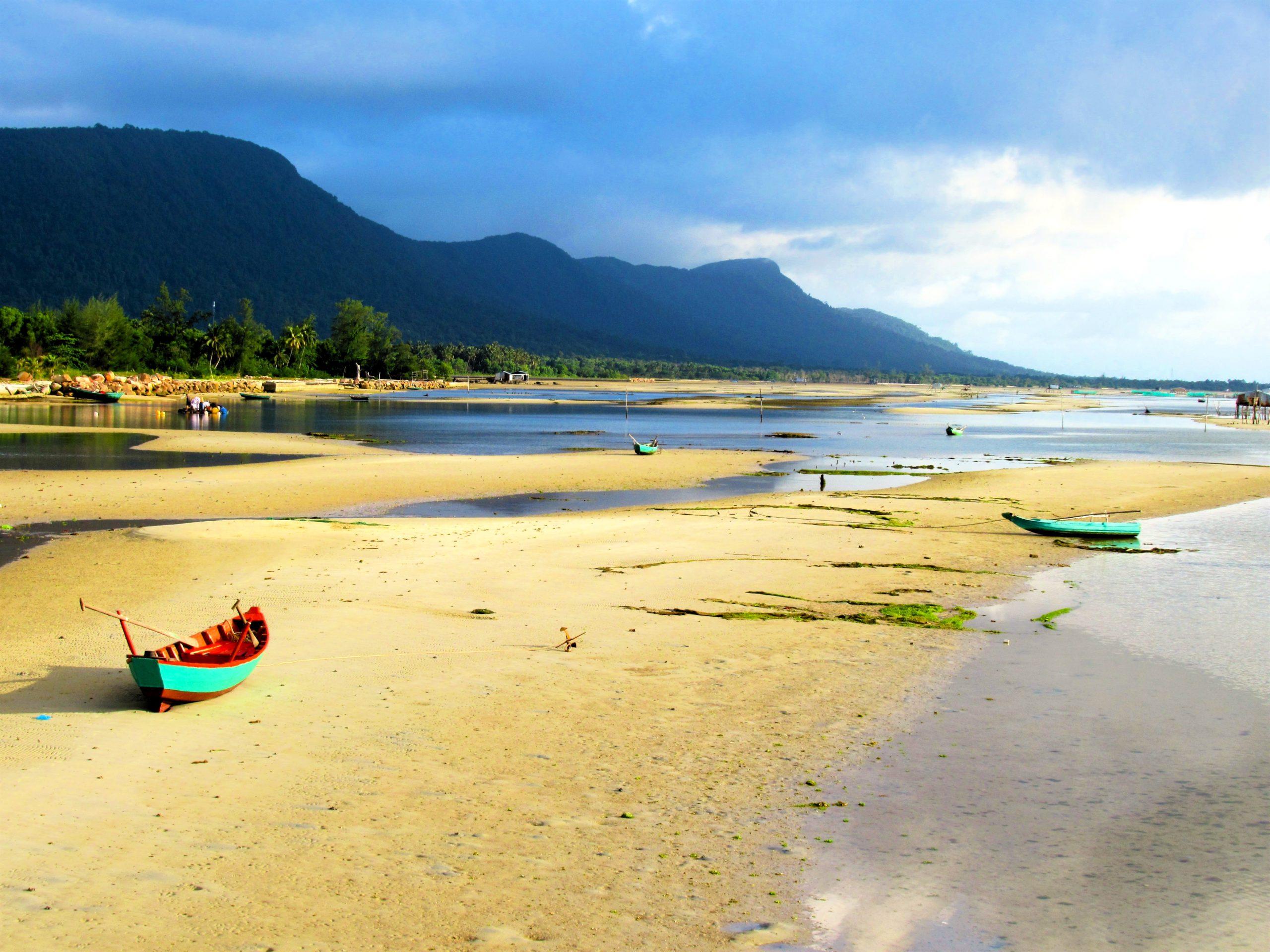
Both islands have good beaches, but of a different nature. Phú Quốc has many kilometres of long, sprawling, palm-fringed sandy beaches lapped by calm waters, especially along the west coast. These are the kind of beaches that invite lying out on a sun lounger, sipping a cocktail, reading a book: the archetypal relaxing tropical beach. By contrast, Côn Đảo’s beaches are fewer, but more rugged and dramatic, with a kind of Jurassic Park quality. These are the kind of beaches that make you reach for your camera before your swimwear. In the right conditions, both Phú Quốc’s and Côn Đảo’s beaches are excellent for swimming, diving, snorkeling and watersports. When it comes to chilling, Phú Quốc’s beaches have the edge; but when it comes to ‘wow factor’, Côn Đảo is the winner. For much more information (and images) of both islands’ beaches see my Phú Quốc Beach Guide and my Côn Đảo Islands Travel Guide. Bottom line: Phú Quốc’s beaches are relaxing; Côn Đảo’s beaches are invigorating.


[Back to Contents]
Natural Environment & Tourist Development:
The pace of change on these two islands could hardly be more different: Phú Quốc has changed beyond recognition over the last decade or so; Côn Đảo remains much the same as it has since I first visited over 15 years ago. There has been far more development on Phú Quốc than on Côn Đảo. The latter’s natural environment - both on land and offshore - is among the best-kept, most well-protected and unscathed anywhere in Vietnam. Côn Đảo’s rugged coastline and mountainous interior are blanketed in thick jungle; most visitors will encounter wildlife, especially long-tailed macaques and black giant squirrels; the sea hides the best snorkeling and dive sites in Vietnam; and the main settlement of Côn Sơn is mostly low-rise and very quiet, laidback and sleepy compared to other Vietnamese towns. Indeed, the island’s population is only around 10,000 in total and visitor numbers - especially those from abroad - are still low. Resort and hotel development has mostly been quite modest and low-rise, and even the bigger, upscale resorts have made an effort to be careful of their environmental impact. It’s not perfect, of course: Côn Đảo has its environmental problems, such as an ever-growing landfill and increasing sea pollution as more and more ferries bring more and more visitors to the island each day. (See my Con Dao Islands Travel Guide for more information.)
But these problems pale in comparison to Phú Quốc’s, where large swathes of rainforest and beachfront have been completely destroyed and then built upon in the most ostentatious and high-impact way imaginable by gigantic integrated resorts. What’s more, with a population of some 180,000 people and hundreds of thousands of tourists arriving each year, the island has a serious litter problem which unfortunately manifests itself in tides of trash washing up on the beach, depending on the season and currents. Having said that, Phú Quốc is a very big island and the development is nowhere near as intense as it is on comparable Thai Islands, such as Phuket. Inland, Phú Quốc’s natural environment is essentially untouched, with miles and miles of unbroken jungle covering ridge after ridge. What’s more, development has been concentrated in specific areas: it’s easy to avoid the high-rise hotels and environmental destruction - most of the coastline remains undeveloped. Phú Quốc has been unfairly treated by travel writers and social media users in recent years who tend to paint the entire island with one brush. (See my Phu Quoc Beach Guide for more information.)
Bottom line: Phú Quốc has been subjected to major development and environmental destruction in pockets, but remains far less developed than regional rivals; Côn Đảo has one of the best protected natural environments in the nation and development has been slow and mostly low-rise.


[Back to Contents]
Accommodation:
Phú Quốc offers a great range of accommodation for all budgets spread across the island, whereas Côn Đảo’s options are far fewer and mostly concentrated around the town on Côn Sơn. On Phú Quốc, competition keeps rates fairly reasonable, but all accommodations inflate their prices during the peak months between November-March. Côn Đảo’s limited sleeping options are generally about 20%-30% more expensive than what you’d expect to pay for similar lodgings on the mainland.
Phú Quốc rivals Hội An for sheer variety of places to stay: budget dorm-style hostels, mid-range beach resorts, high-end getaways, huge multistorey hotels, local guesthouses - they’re all here in abundance. In amongst the hundreds of accommodations (the vast majority of which are spread along the west coast) are a handful of truly excellent places to stay that are among my favourite resorts in Vietnam. (See my Phú Quốc Hotel Reviews for more information.)
On Côn Đảo, several dozen mini-hotels dot the quiet streets of Côn Sơn town. Standards are getting higher and the range of choices increases with each year. As a general rule, the more upmarket and pricier options are along the handsome seafront road; things get progressively cheaper the further back you go. Beyond town, there are a handful of secluded, luxury resorts on private beaches. (See my Côn Đảo Accommodation Reviews for more information.) Bottom line: Phú Quốc has a huge range of places to stay with something for everyone; Côn Đảo has limited - but ever growing - options.


[Back to Contents]
Dining & Nighlife:
Unsurprisingly, seafood is famous on both islands. Phú Quốc also has some island speciality dishes and several decent nightlife options. Côn Đảo, on the other hand, has no nightlife (a relief for some; a disappointment for others), save for a handful of cocktail bars and a stroll along the seafront promenade.
When it comes to dining, Phú Quốc has everything from local eateries to fine dining, from seafood shacks to burger joints, from homemade pizza to street food carts. The seafood night market in Dương Đông town is bustling and popular, but in reality it is a bit of a tourist trap. The best way to enjoy Phú Quốc’s seafood is at one of many local restaurants scattered along the coastline. (See my guide Where to Eat Seafood on Phu Quoc for more information.) Phú Quốc has two speciality noodle dishes, both of which can be sampled in Dương Đông town: see Bún Kèn and Bún Quậy for details. All the hotels and resorts have decent restaurants, some of which are exceptional, such as Pakka Indian at Salinda Resort and On the Rocks at Mango Bay. In addition, there’s lots of local street food available in Dương Đông and many Vietnamese and international restaurants lining Trần Hưng Đạo street leading south of town: Italian, Korean, Spanish, Thai, American BBQ - you’ll find it all. After dinner drinking options are plentiful: speakeasy bars, beach bars, rooftop bars, backpacker bars and pubs, many of which stay open into the small hours with live music or DJs. (See my 21 Places for Cocktails on Phu Quoc for details.)
Côn Đảo’s dining scene has greatly improved over the last few years, partly helped by an influx of domestic migrants arriving from all corners of the nation to set up business on the island. Apart from a few resorts, all dining options are located in the town of Côn Sơn. A seafood and street food night market was established recently and has proven to be very popular. Open-air stalls set up on the concrete next to the main market (Chợ Côn Đảo) from 5pm until late. Other seafood restaurants are dotted around town, all serving screamingly fresh fish, shellfish and crustaceans. International options are few, but there are several good places for burgers, pasta and pizza. Beach House is an exceptional little place run by enterprisingly young Vietnamese friends, specializing is freshly made fusion dishes; the menu is constantly changing. For dessert, try Côn Đảo’s speciality: kem dừa (coconut ice cream). A few good, cosy cocktail bars constitute the only nightlife of the island. (See my Con Dao Eat & Drink Guide for more information.) Bottom line: Phú Quốc has lots of local and international dining options as well as bars and nightlife; Côn Đảo has a limited but growing food scene and no (i.e. quite) nightlife.


[Back to Contents]
Sights & Activities:
Both islands have plenty of outdoor activities that make the most of the tropical island setting: diving, snorkeling, island-hopping, fishing, hiking, waterfalls, boat trips and motorbiking. In addition, Phú Quốc has large-scale entertainment complexes featuring waterparks, theme parks, safari parks, cable cars, shopping centres, sound and light performances and the like. Côn Đảo, on the other hand, has more cultural and historical sights, such as museums, temples and colonial architecture.
The small An Thới Islands, off Phú Quốc’s southern tip, are popular for snorkeling and diving trips. Inland, there are a few hiking trails, such as Đỉnh Tiên Sơn Peak, and waterfalls (see my Spring-Hopping Loop), both of which make a nice break from all of the coastal activities. Night squid fishing is an interesting addition to the activities on the island: take a fishing boat out at dusk with a small group, catch your squid, then cook and eat it on board. Phú Quốc is famous nationwide for the quality of its fish sauce and black pepper: both can be sampled on tours of factories and plantations respectively. While there are several historical sights on the island, such as Coconut Tree Prison (Nhà Tù Cây Dừa) and temples to local hero Nguyễn Trung Trực, the focus is mainly on having fun in the sun. Nowhere is this more apparent than at the gigantic entertainment complexes that bookend the island: VinWonders in the northwest, Sun World in the southwest. These ostentatious developments aren’t to my taste and they are responsible for huge destruction of the natural environment, but they remain a popular way to spend the day for many thousands of travelling families. Personally, I prefer to rent a motorbike and explore the island’s roads, especially the eastern and northern coast roads, and perhaps do some beach camping. All of the above sights and activities are easily arranged through your accommodation or you can organize any of them via local travel agents on the street.
Côn Đảo’s sights and attractions are divided between the historical and the natural. The vast majority of visitors to Côn Đảo are Vietnamese, and for many of them the main reason for coming is to tour the former prison sites and pay their respects to those who were incarcerated or died here. Côn Đảo was used as a prison island for over a century by the French colonial administration, beginning in 1862. Thousands of political prisoners - many of them now celebrated national heroes - were held, mistreated and died here. This dark past is preserved today as a memorial to the victims: the prisons can be visited as well as other historical buildings related to the prison system - some of them are handsome French colonial buildings, such as the old Customs House on the seafront, which bely their use. There’s also a large and interesting museum documenting the island’s history, as well as many shrines and cemeteries where tens of thousands of Vietnamese come to pray and pay their respects every year. These rather grim sights are juxtaposed with Côn Đảo’s other major attraction - the one that most foreign travellers come here for - the natural environment. Riding along the dramatic, deserted coast roads is thrilling and inland there are a half dozen well-marked hiking trails through the jungle to isolated beaches (see my guide Hiking Con Dao). Boat trips to the outlying islands are fascinating (see my Con Dao Boat Trips Guide) and the snorkeling and diving is the best in Vietnam. For much more information about all of the above, see my Con Dao Islands Travel Guide. Bottom line: Phú Quốc for classic tropical island activities and big entertainment complexes; Côn Đảo for historical sites and natural attractions.


[Back to Contents]
Costs & Value for Money:
Like all islands, prices on Côn Đảo and Phú Quốc are a little higher than on the mainland. In particular, most general expenses on Côn Đảo are around 10%-30% higher than elsewhere in Vietnam. This is partly because the island is so small and mountainous that very little can be produced there - almost everything has to be shipped in from the mainland - but also because Côn Đảo has not seen the same amount of tourist development that Phú Quốc has, so there’s not much competition to drive prices down. Hotels, resorts, food and drink, transport and excursions to outlying islands are all pricier than on Phú Quốc. And what you get for your money on Côn Đảo often pales in comparison to what the same money would buy you on Phú Quốc. However, this is all relative: both Phú Quốc and Côn Đảo are still very inexpensive destinations compared to most countries in Europe, North America and Australasia.
Accommodation, tours, and food and drink are all good value for money on Phú Quốc. In particular, the building boom for hotels and resorts over the last decade has led to an oversupply - especially in the post-pandemic era - which keeps prices reasonable. Having said that, during the peak season (December to March/April) all accommodations raise their rates by as much as 50%. Likewise, in the low season - when storms often hit the island - resort prices fall dramatically. In general, if you’re trying to stay within a tight budget, then it’s easier to do so on Phú Quốc than on Côn Đảo. Bottom line: Phú Quốc offers better value for money for travellers on all budgets; Côn Đảo prices are generally higher than elsewhere: budget travel is possible, but requires a bit more effort to keep costs down.


*Disclosure: I never receive payment for anything I write: my content is always free and independent. I’ve written this guide because I want to: I like these islands and I want my readers to know about them. For more details, see my Disclosure & Disclaimer statements and my About Page
[Back to Contents]
Link nội dung: https://superkids.edu.vn/con-quoc-quoc-a16702.html