
Minkowski inequality
In mathematical analysis, the Minkowski inequality establishes that the L p {displaystyle L^{p}} 
Let S {textstyle S} 


‖ f + g ‖ p ≤ ‖ f ‖ p + ‖ g ‖ p {displaystyle |f+g|_{p}leq |f|_{p}+|g|_{p}} 
with equality for 1 < p < ∞ {textstyle 1<p<infty } 


‖ f ‖ p = ( ∫ | f | p d μ ) 1 p {displaystyle |f|_{p}=left(int |f|^{p}dmu right)^{frac {1}{p}}} 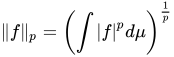
if p < ∞ , {textstyle p<infty ,} 

‖ f ‖ ∞ = e s s s u p x ∈ S | f ( x ) | . {displaystyle |f|_{infty }=operatorname {ess sup} _{xin S}|f(x)|.} 
The Minkowski inequality is the triangle inequality in L p ( S ) . {textstyle L^{p}(S).}
‖ f ‖ p = sup ‖ g ‖ q = 1 ∫ | f g | d μ , 1 p + 1 q = 1 {displaystyle |f|_{p}=sup _{|g|_{q}=1}int |fg|dmu ,qquad {tfrac {1}{p}}+{tfrac {1}{q}}=1} 
where it is easy to see that the right-hand side satisfies the triangular inequality.
Like Hölder's inequality, the Minkowski inequality can be specialized to sequences and vectors by using the counting measure:
( ∑ k = 1 n | x k + y k | p ) 1 / p ≤ ( ∑ k = 1 n | x k | p ) 1 / p + ( ∑ k = 1 n | y k | p ) 1 / p {displaystyle left(sum _{k=1}^{n}|x_{k}+y_{k}|^{p}right)^{1/p}leq left(sum _{k=1}^{n}|x_{k}|^{p}right)^{1/p}+left(sum _{k=1}^{n}|y_{k}|^{p}right)^{1/p}} 
for all real (or complex) numbers x 1 , … , x n , y 1 , … , y n {textstyle x_{1},dots ,x_{n},y_{1},dots ,y_{n}} 

In probabilistic terms, given the probability space ( Ω , F , P ) , {displaystyle (Omega ,{mathcal {F}},mathbb {P} ),} 


![{displaystyle left(mathbb {E} [|X+Y|^{p}]right)^{frac {1}{p}}leqslant left(mathbb {E} [|X|^{p}]right)^{frac {1}{p}}+left(mathbb {E} [|Y|^{p}]right)^{frac {1}{p}}.}](https://wikimedia.org/api/rest_v1/media/math/render/svg/d5cf48177bbce10cb6a31fd118c2436cab6765f1)
First, we prove that f + g {textstyle f+g} 
| f + g | p ≤ 2 p − 1 ( | f | p + | g | p ) . {displaystyle |f+g|^{p}leq 2^{p-1}(|f|^{p}+|g|^{p}).} 
Indeed, here we use the fact that h ( x ) = | x | p {textstyle h(x)=|x|^{p}} 


| 1 2 f + 1 2 g | p ≤ | 1 2 | f | + 1 2 | g | | p ≤ 1 2 | f | p + 1 2 | g | p . {displaystyle left|{tfrac {1}{2}}f+{tfrac {1}{2}}gright|^{p}leq left|{tfrac {1}{2}}|f|+{tfrac {1}{2}}|g|right|^{p}leq {tfrac {1}{2}}|f|^{p}+{tfrac {1}{2}}|g|^{p}.} 
This means that
| f + g | p ≤ 1 2 | 2 f | p + 1 2 | 2 g | p = 2 p − 1 | f | p + 2 p − 1 | g | p . {displaystyle |f+g|^{p}leq {tfrac {1}{2}}|2f|^{p}+{tfrac {1}{2}}|2g|^{p}=2^{p-1}|f|^{p}+2^{p-1}|g|^{p}.} 
Now, we can legitimately talk about ‖ f + g ‖ p {textstyle |f+g|_{p}} 
‖ f + g ‖ p p = ∫ | f + g | p d μ = ∫ | f + g | ⋅ | f + g | p − 1 d μ ≤ ∫ ( | f | + | g | ) | f + g | p − 1 d μ = ∫ | f | | f + g | p − 1 d μ + ∫ | g | | f + g | p − 1 d μ ≤ ( ( ∫ | f | p d μ ) 1 p + ( ∫ | g | p d μ ) 1 p ) ( ∫ | f + g | ( p − 1 ) ( p p − 1 ) d μ ) 1 − 1 p Hölder's inequality = ( ‖ f ‖ p + ‖ g ‖ p ) ‖ f + g ‖ p p ‖ f + g ‖ p {displaystyle {begin{aligned}|f+g|_{p}^{p}&=int |f+g|^{p},mathrm {d} mu &=int |f+g|cdot |f+g|^{p-1},mathrm {d} mu &leq int (|f|+|g|)|f+g|^{p-1},mathrm {d} mu &=int |f||f+g|^{p-1},mathrm {d} mu +int |g||f+g|^{p-1},mathrm {d} mu &leq left(left(int |f|^{p},mathrm {d} mu right)^{frac {1}{p}}+left(int |g|^{p},mathrm {d} mu right)^{frac {1}{p}}right)left(int |f+g|^{(p-1)left({frac {p}{p-1}}right)},mathrm {d} mu right)^{1-{frac {1}{p}}}&&{text{ Hölder's inequality}}&=left(|f|_{p}+|g|_{p}right){frac {|f+g|_{p}^{p}}{|f+g|_{p}}}end{aligned}}} 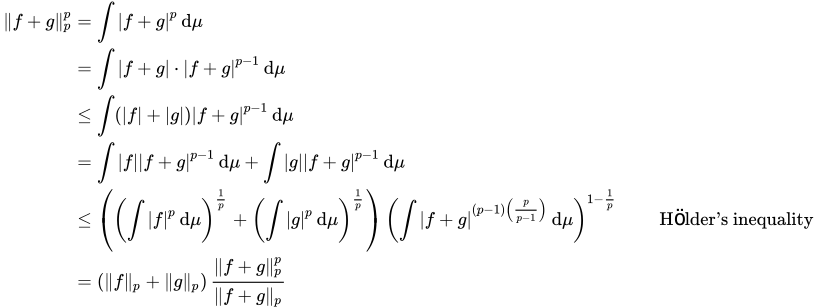
We obtain Minkowski's inequality by multiplying both sides by
‖ f + g ‖ p ‖ f + g ‖ p p . {displaystyle {frac {|f+g|_{p}}{|f+g|_{p}^{p}}}.} 
Given t ∈ ( 0 , 1 ) {displaystyle tin (0,1)} 


By integration this leads to
∫ S | f + g | p d μ ≤ 1 ( 1 − t ) p − 1 ∫ S | f | p d μ + 1 t p − 1 ∫ S | g | p d μ . {displaystyle int _{S}|f+g|^{p},mathrm {d} mu leq {frac {1}{(1-t)^{p-1}}}int _{S}|f|^{p},mathrm {d} mu +{frac {1}{t^{p-1}}}int _{S}|g|^{p},mathrm {d} mu .}
One takes then
t = ‖ g ‖ p ‖ f ‖ p + ‖ g ‖ p {displaystyle t={frac {Vert gVert _{p}}{Vert fVert _{p}+Vert gVert _{p}}}}
to reach the conclusion.
Suppose that ( S 1 , μ 1 ) {textstyle (S_{1},mu _{1})} 


[ ∫ S 2 | ∫ S 1 F ( x , y ) μ 1 ( d x ) | p μ 2 ( d y ) ] 1 p ≤ ∫ S 1 ( ∫ S 2 | F ( x , y ) | p μ 2 ( d y ) ) 1 p μ 1 ( d x ) , p ∈ [ 1 , ∞ ) {displaystyle left[int _{S_{2}}left|int _{S_{1}}F(x,y),mu _{1}(mathrm {d} x)right|^{p}mu _{2}(mathrm {d} y)right]^{frac {1}{p}}~leq ~int _{S_{1}}left(int _{S_{2}}|F(x,y)|^{p},mu _{2}(mathrm {d} y)right)^{frac {1}{p}}mu _{1}(mathrm {d} x),quad pin [1,infty )} ![{displaystyle left[int _{S_{2}}left|int _{S_{1}}F(x,y),mu _{1}(mathrm {d} x)right|^{p}mu _{2}(mathrm {d} y)right]^{frac {1}{p}}~leq ~int _{S_{1}}left(int _{S_{2}}|F(x,y)|^{p},mu _{2}(mathrm {d} y)right)^{frac {1}{p}}mu _{1}(mathrm {d} x),quad pin [1,infty )}](https://wikimedia.org/api/rest_v1/media/math/render/svg/64328c73ed7f4f2144bbb15925432792594de978)
with obvious modifications in the case p = ∞ . {textstyle p=infty .} 




If μ 1 {textstyle mu _{1}} 


‖ f 1 + f 2 ‖ p = ( ∫ S 2 | ∫ S 1 F ( x , y ) μ 1 ( d x ) | p μ 2 ( d y ) ) 1 p ≤ ∫ S 1 ( ∫ S 2 | F ( x , y ) | p μ 2 ( d y ) ) 1 p μ 1 ( d x ) = ‖ f 1 ‖ p + ‖ f 2 ‖ p . {displaystyle |f_{1}+f_{2}|_{p}=left(int _{S_{2}}left|int _{S_{1}}F(x,y),mu _{1}(mathrm {d} x)right|^{p}mu _{2}(mathrm {d} y)right)^{frac {1}{p}}leq int _{S_{1}}left(int _{S_{2}}|F(x,y)|^{p},mu _{2}(mathrm {d} y)right)^{frac {1}{p}}mu _{1}(mathrm {d} x)=|f_{1}|_{p}+|f_{2}|_{p}.} 
If the measurable function F : S 1 × S 2 → R {textstyle F:S_{1}times S_{2}to mathbb {R} } 
‖ ‖ F ( ⋅ , s 2 ) ‖ L p ( S 1 , μ 1 ) ‖ L q ( S 2 , μ 2 ) ≤ ‖ ‖ F ( s 1 , ⋅ ) ‖ L q ( S 2 , μ 2 ) ‖ L p ( S 1 , μ 1 ) . {displaystyle left|left|F(,cdot ,s_{2})right|_{L^{p}(S_{1},mu _{1})}right|_{L^{q}(S_{2},mu _{2})}~leq ~left|left|F(s_{1},cdot )right|_{L^{q}(S_{2},mu _{2})}right|_{L^{p}(S_{1},mu _{1})} .} 
This notation has been generalized to
‖ f ‖ p , q = ( ∫ R m [ ∫ R n | f ( x , y ) | q d y ] p q d x ) 1 p {displaystyle |f|_{p,q}=left(int _{mathbb {R} ^{m}}left[int _{mathbb {R} ^{n}}|f(x,y)|^{q}mathrm {d} yright]^{frac {p}{q}}mathrm {d} xright)^{frac {1}{p}}} ![{displaystyle |f|_{p,q}=left(int _{mathbb {R} ^{m}}left[int _{mathbb {R} ^{n}}|f(x,y)|^{q}mathrm {d} yright]^{frac {p}{q}}mathrm {d} xright)^{frac {1}{p}}}](https://wikimedia.org/api/rest_v1/media/math/render/svg/378fb353fca1c3274d623037524f0b25d84d29f4)
for f : R m + n → E , {textstyle f:mathbb {R} ^{m+n}to E,} 


When p < 1 {textstyle p<1} 
‖ f + g ‖ p ≥ ‖ f ‖ p + ‖ g ‖ p . {displaystyle |f+g|_{p}geq |f|_{p}+|g|_{p}.} 
We further need the restriction that both f {textstyle f} 


The reverse inequality follows from the same argument as the standard Minkowski, but uses that Holder's inequality is also reversed in this range.
Using the Reverse Minkowski, we may prove that power means with p ≤ 1 , {textstyle pleq 1,} 
The Minkowski inequality can be generalized to other functions ϕ ( x ) {textstyle phi (x)} 

ϕ − 1 ( ∑ i = 1 n ϕ ( x i + y i ) ) ≤ ϕ − 1 ( ∑ i = 1 n ϕ ( x i ) ) + ϕ − 1 ( ∑ i = 1 n ϕ ( y i ) ) . {displaystyle phi ^{-1}left(textstyle sum limits _{i=1}^{n}phi (x_{i}+y_{i})right)leq phi ^{-1}left(textstyle sum limits _{i=1}^{n}phi (x_{i})right)+phi ^{-1}left(textstyle sum limits _{i=1}^{n}phi (y_{i})right).} 
Various sufficient conditions on ϕ {textstyle phi } 

- ϕ ( x ) {textstyle phi (x)}
- ϕ ( x ) {textstyle phi (x)}
- log ϕ ( x ) {textstyle log phi (x)}
is a convex function of log ( x ) . {textstyle log(x).}


- Cauchy-Schwarz inequality - Mathematical inequality relating inner products and norms
- Hölder's inequality - Inequality between integrals in Lp spaces
- Mahler's inequality
- Young's convolution inequality - Mathematical inequality about the convolution of two functions
- Young's inequality for products - Mathematical concept
- Bahouri, Hajer; Chemin, Jean-Yves; Danchin, Raphaël (2011). Fourier Analysis and Nonlinear Partial Differential Equations. Grundlehren der mathematischen Wissenschaften. Vol. 343. Berlin, Heidelberg: Springer. ISBN 978-3-642-16830-7. OCLC 704397128.
- Hardy, G. H.; Littlewood, J. E.; Pólya, G. (1988). Inequalities. Cambridge Mathematical Library (second ed.). Cambridge: Cambridge University Press. ISBN 0-521-35880-9.
- Minkowski, H. (1953). Geometrie der Zahlen. Chelsea..
- Stein, Elias (1970). Singular integrals and differentiability properties of functions. Princeton University Press..
- M.I. Voitsekhovskii (2001) [1994], "Minkowski inequality", Encyclopedia of Mathematics, EMS Press
- Lohwater, Arthur J. (1982). "Introduction to Inequalities".
- Bullen, P. S. (2003). "The Power Means". Handbook of Means and Their Inequalities. Dordrecht: Springer Netherlands. pp. 175-265. doi:10.1007/978-94-017-0399-4_3. ISBN 978-90-481-6383-0. Retrieved 2022-06-23.
Link nội dung: https://superkids.edu.vn/mincopxki-a43140.html